
The 1991 Peace Day Riots – Luton
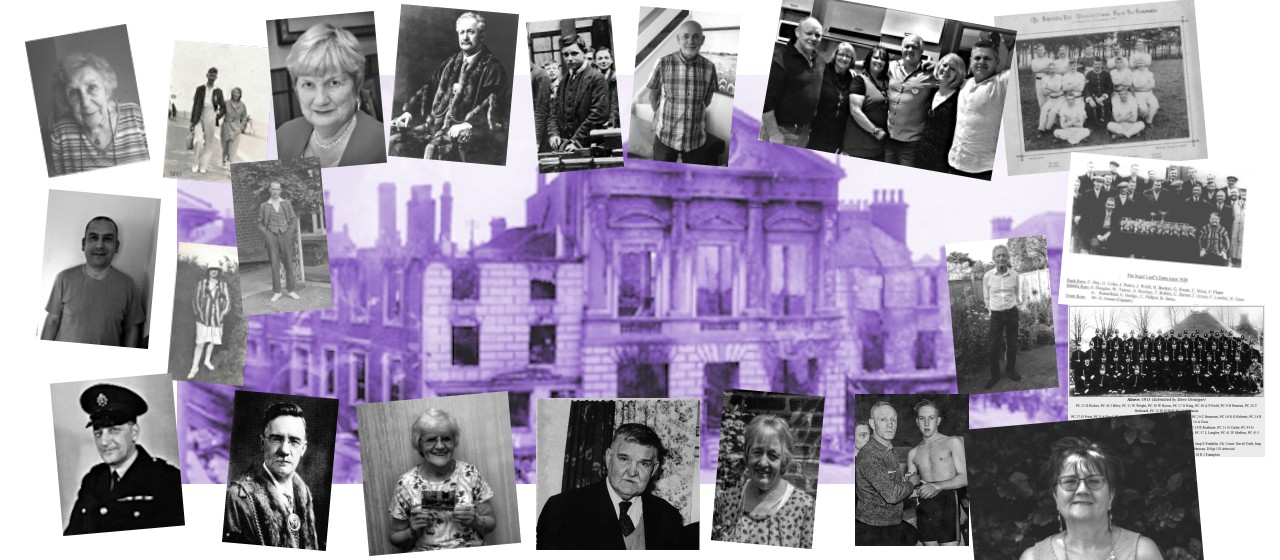
Throughout the UK July 19th, 1919 was designated as Peace Day to celebrate the end of the First World War. In Luton the day ended in a riot with Mayor Impey fleeing disguised as a policemen and the Town Hall being burnt down.
The council had organised festivities – including a banquet that former servicemen could attend if they paid the fee of 15 shillings (equivalent to £0.75p in today’s money and equivalent, to those in work, to half a week’s salary), whilst councillors dined free at ratepayer’s expense. Former servicemen’s groups boycotted the events to protest against unemployment and high food prices – councillors were accused of profiteering. The mayor, Henry Impey, read a message from the King at the town hall but was jeered and booed. He retreated inside with council officers and fled through a back door disguised as a police special constable. Fuelled with drink from the numerous local hostelries rioters set fire to the Town Hall later that night and in additon prevented the fire brigade from reaching it and extinghuishing the fire.
As the Town Hall burnt people dragged pianos from a nearby music store into the street, singing, dancing and allegedly playing Keep The Home Fires Burning as the Town Hall blazed in the background. Stories of the riots, and the people involved, have lived on in families’ memories.
Throughout March and April 2019, The Cutltural History CIC supported a small team of volunteers who collected those family stories about the Luton 1919 Peace Day Riots. Trained volunteers collected family stories / memories about the riots. They were interested in as many stories as possible, no matter how small; they wanted to hear what people did on the day but also what they did during the war and after the riot. It didn’t matter how small the story was – the important part was that it was a story and it contributed to the archive of the events of July 1919 that could be stored for future generations to enjoy and research.
The following is a collection of those family stories with supporting photographs and audio files of the person relating the story. (click the plus sign to open and close each story). The audio files are stored in the University of Hertfordshire audio archive.
Born to Riot – Victor Samm
Victor Samm was born on the day of the riots . A newspaper headline the day after the riot was “Victory for the people “ – and so his parents decided to call him Victor in honour of the rioters.
This player uses cookies in accordance with soundcloud’s cookies policy. They may collect usage data for analytics purposes.
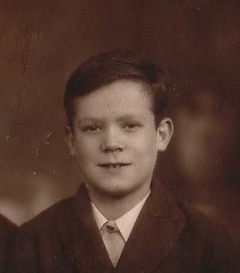
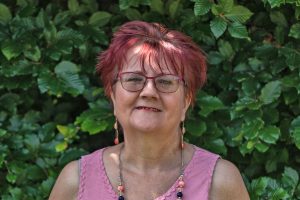
The person speaking is Jan Ross – shown above – daughter of Victor Samm, also shown above from a school photograph.
Veteran, Rioter and Entertainer – John Henry Goode
John Henry Goode served at the Somme and Passchendaele. He led the rioters in the afternoon and was at the front when they broke down the town hall doors. In the evening he played a piano dragged into the street from Farmer’s music shop. He was jailed for six weeks. He did many jobs after the war including window cleaning, paying children a penny to do the upper windows as he was scared of heights. Goode was known as Kissing Cup around town as he would recite poetry in pubs – in exchange for a pint.
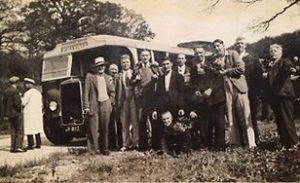
John Henry Goode is the right-hand most person in the above image.
Fighter’s Story – Henry Miles
Henry Miles, a prize fighter from east London who fought as Jack Daley, moved to Luton to work as a cinema projectionist. He fought at Ypres and was awarded the Military Medal for bravery at the Battle of St Julien. Instead of coming home to a land fit for heroes he found a council unsympathetic to old soldiers and allegedly mismanaging food rations. After the mayor fled the town hall Henry led a crowd of about 500 to his house but he was not there. Henry was arrested and made to walk from his home to the police station with his ankles and legs chained. Rich relatives paid for a lawyer who argued that Henry was suffering shell shock and he was cleared. He went on to work for the council and joined the Home Guard in the Second World War before being killed in an air raid on Luton.
This player uses cookies in accordance with soundcloud’s cookies policy. They may collect usage data for analytics purposes.
Keith Miles, grandson.
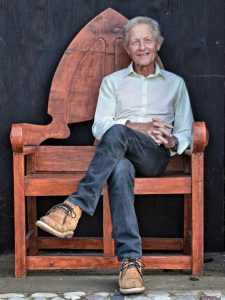
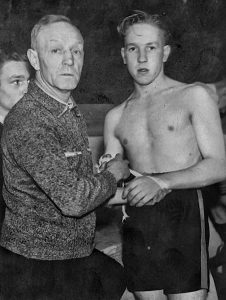
Keith Miles (grandson to Henry Miles) shown in the left hand image above. Henry Miles is the young boxer in the right hand image.
Pension Protest – Ephraim Gore
Ephraim Gore was prosecuted for climbing the town hall, pulling down electric lights, setting fire to decorative flags and making a speech. He said the speech was only about his pension and the workhouse. Gore was jailed for nine months. He was originally sentenced to hard labour but that was reduced after Gore pleaded that he would lose his army pension. He had more than 40 previous convictions including theft, poaching and fighting but was never in trouble with the police again after 1919.
This player uses cookies in accordance with soundcloud’s cookies policy. They may collect usage data for analytics purposes.
Gail Sidebotham, great, great-niece.
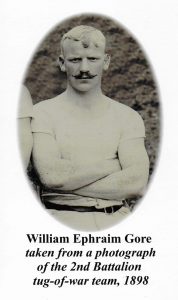
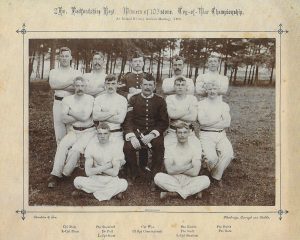
Up the Hatters – Charles Dillingham
Charles Dillingham, a hat maker who was mayor of Luton before Henry Impey, showed King George V round munitions works and Kents on his second day in office. He was on the Peace Day committee and his warehouse premises, opposite the town hall, were damaged in the riots. His relative, Diane Cullen, says her great aunt, Rose Clark, was at the riots and tried to stab the firemen’s hoses with her hat pin.
This player uses cookies in accordance with soundcloud’s cookies policy. They may collect usage data for analytics purposes.
Diane Cullen (shown below)
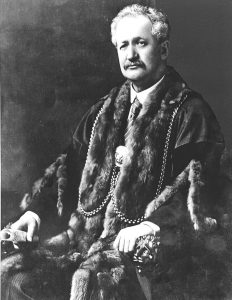
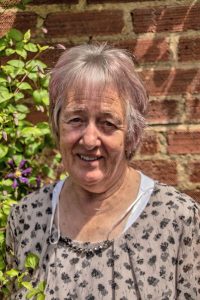
Charles Dillingham and Diane Cullen (above right)
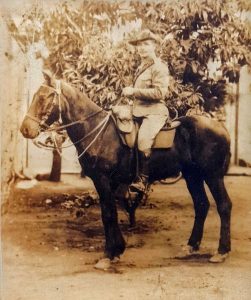
Picture of William Thoroughgood, mentioned in Diane’s story, taken during the Boer War. William took a pair of shoes from a looted shop but they were two left feet! The shoe shop was next door to Farmers Music Shop on the corner of Wellington Street and Upper George Street
Medal Burner – George Bodsworth
George Bodsworth took part in the Retreat from Mons. After being invalided out of the army he returned for another year, finally leaving in 1920. He was outside the town hall between 1pm and 1am at the time of the riots and seen shouting and waving a stick. George was sentenced to three months in prison for hitting a police constable, which he denied. George later burned his war medals and set up a fruit and vegetable business. Martin Fensome, his grandson, says trial records show the rioters were “lovable rogues” who had good reasons for their actions.
This player uses cookies in accordance with soundcloud’s cookies policy. They may collect usage data for analytics purposes.
Martin Fensome, grandson.
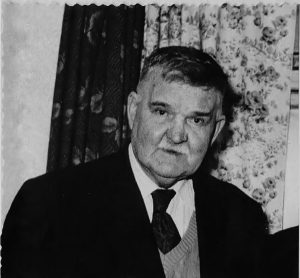
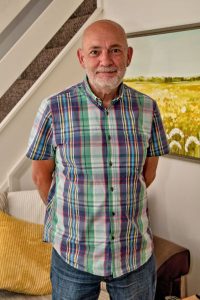
George Bodsworth (left) and his grandson Martin Fensome (right).
Jolly Fellow – Eric Victor Thompson
Eric Victor Thompson was 13 when he went to see the Peace Day parade with his brother. He smashed some shop windows and came home with a pair of shoes, only to find they were both for left feet. He sung “We are the Jolly Fellows, yes we are, we come from Luton Town, where they burned the town hall down” to his daughter, Shirley Hobbs, and told her stories of seaside landladies banning Lutonians from their guest houses.
This player uses cookies in accordance with soundcloud’s cookies policy. They may collect usage data for analytics purposes.
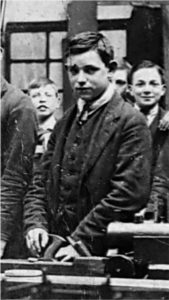
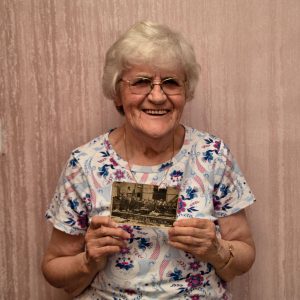
Eric Victor Thompson (left) and his daughter Shirley Hobbs (right).
The vingette of Eric Victor Thompson is taken from the postcard/photograph being held by Shirley, a copy of which can be seen below.
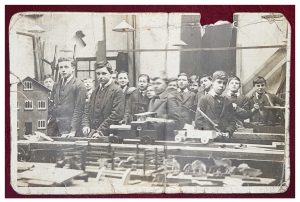
The reverse side contains some hand written notes which are quite difficult to make out.
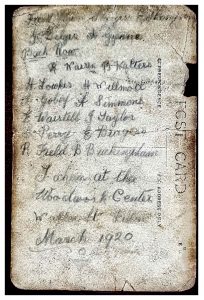
Front Row Sturgess, E. V. Thompson
G. Delger, A Gyage
Back Row
R. Warren, B. Kalters,
H. Loakes, H. Willmott,
A. Golby, A. Simmons
E. Waistell, J Taylor
? Perry, E Burgess
R Field, B. Buckingham
Taken at the Woodwork Center
Wallen St, Luton
March 1920.
Mayor Scapegoated – Henry Impey
Henry Impey’s great great-niece, Sandy Taylor was told stories about the mayor by her mother. He worked for the council for 20 years before becoming mayor and said reading the king’s proclamation of the Peace Day was one of the highlights of his life. He chaired the Board of Guardians that helped the town’s children, belonged to the allotment association that allowed more than 1,500 people to lease council land to feed themselves and was a lay preacher. But newspapers wanted to blame someone for the riots and other councillors put his name forward. The town clerk, William Smith (see below – Ordered Home), and chief constable advised him to leave the town and he became a magistrate in Sutton on Sea, Lincolnshire, and chaired the council. Sandy says riots – across the country, not just in Luton – were a response to unemployment, poor housing and high food prices. She accepts that the mayor was a target for the demonstrators’ anger but feels attempts to put all the blame on Mr Impey have treated him unfairly.
This player uses cookies in accordance with soundcloud’s cookies policy. They may collect usage data for analytics purposes.
Sandy Taylor, great-great niece.
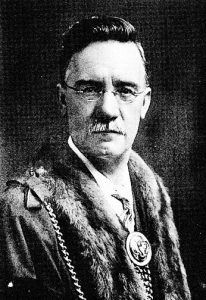
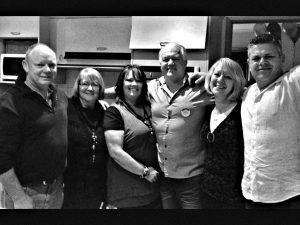
Mayor Impey and the modern-day Australia-based Impey family members
Safe Distance – George Buggs
George Buggs was a former soldier who had been captured and held as a prisoner of war. After rioters broke into Farmer’s music shop and took pianos into the street he was arrested, accused of saying “and now for the safe”. George was cleared after the court was told that he just watched the fire and never went near the shops.
This player uses cookies in accordance with soundcloud’s cookies policy. They may collect usage data for analytics purposes.
Catherine Howe, niece.
Hard Labour – Freddie Plater
Freddie Plater received the harshest sentence at Bedford crown court: three years’ hard labour. He had served two years in France and been badly wounded. On the day of the riot he was dressed as a vicar and jumped on fire engines to stop firemen putting out the blaze. He was arrested the next day.
This player uses cookies in accordance with soundcloud’s cookies policy. They may collect usage data for analytics purposes.
Mike Allen, local historian.
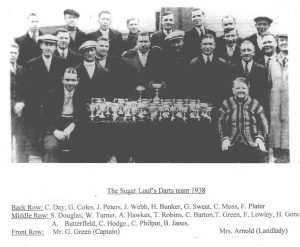
The Sugar Loaf PH darts team 1938. Freddy Plater is at the right hand end of the back row wearing a cap.
Brothers in Police – Edmund James
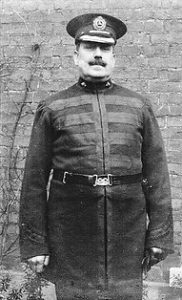
Edmund James joined the town police force in his early 20s. He weighed 20 stone and was put at the front of the town hall on Peace Day, holding back growing numbers of demonstrators. As the crowd grew his brother, Fred, a chief inspector arrived from Wardown Park with reinforcements. When a group went to the mayor’s house Fred and another senior officer went with them and spoke with the demonstrators before they returned to the town hall. Edmund was badly injured in the riots and three years later retired from the force on medical grounds. Their great-grandsons, Gavin Dadd and Tony Ireland, said the family felt the rioters had some justified grievances. Indeed the police themselves went on strike in some parts of the country. There was no animosity towards police after the riots as they were seen as having done their job. Both brothers knew some of the rioters personally.
This player uses cookies in accordance with soundcloud’s cookies policy. They may collect usage data for analytics purposes.
This player uses cookies in accordance with soundcloud’s cookies policy. They may collect usage data for analytics purposes.
Gavin Dadd and Tony Ireland, great grandsons.
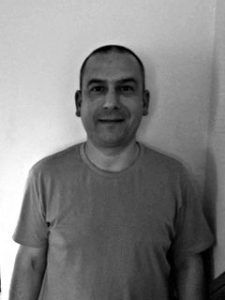
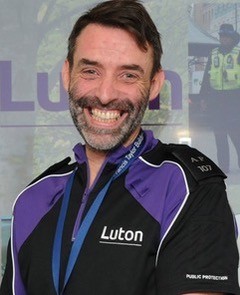
Gavin Dadd and Tony Ireland – great grandsons of one of the Policemen on duty that day.
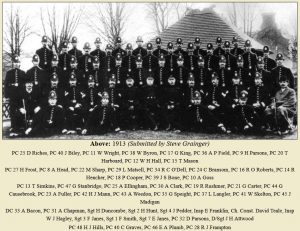
The above photograph of the Luton Borough Police force 1913 includes Sargents F. Janes and E. Janes in the front row. Image used with permission of British Police History website. Sargent E Janes is second policeman in front seated row (not on the floor) from the right hand end – seen in the vingette below. Sgt F Janes is seated 2 places to his brother’s left.
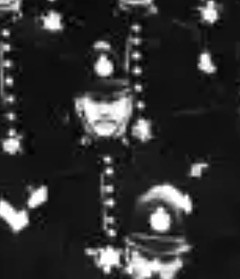
Sargents E. Janes and F. Janes.
Riot Police – Albert Joseph Sear
Albert Joseph Sear was policing the demonstration at the town hall on his second day in the force. He joined the police after being wounded at Gallipoli – at the age of 80 a hospital X-ray showed he still had a bullet in his shoulder. He was injured in the rioting and had a scar on his ear for the rest of his life but his daughter, Iris Purvis believes her father had some sympathy for the demonstrators. He was awarded the George Medal in the Second World War for helping defuse an unexploded bomb and retired, as a chief superintendent, in 1953. Iris’s mother told her about the crowd singing round a grand piano in the street. She said Lutonians kept quiet about where they were from after the riot because Luton became known as a lawless town.
This player uses cookies in accordance with soundcloud’s cookies policy. They may collect usage data for analytics purposes.
Iris Purvis, daughter
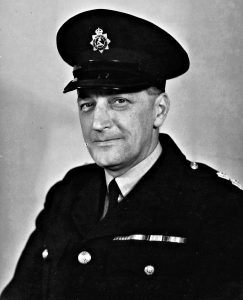
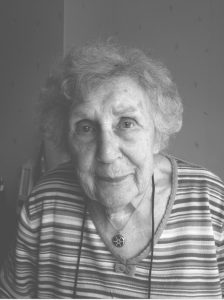
Albert Joesph Sear (left) and his daughter Iris Purvis (right).
Ordered Home – Eve May Hurry
Eve May Hurry was the town clerk’s secretary. On the day of the riot the clerk, William Smith, told her to go home. She refused at first but when she heard the mob breaking down the doors of the town hall she left. She had lost two brothers at Passchendale.
This player uses cookies in accordance with soundcloud’s cookies policy. They may collect usage data for analytics purposes.
Roger Goodwin, grandson of Eve May Hurry.
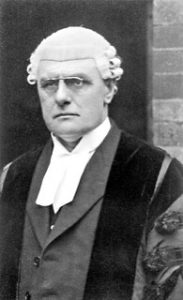
William Smith, Town Clerk. Image copied from a photograph, negative, object or document in the Wardown House Museum & Gallery collection.
Rabbit Run – Arthur Perry
Arthur Perry, who worked at Lye & Sons dye works, was held overnight with several men who had been drinking in the Rabbit pub. He was released in the morning. Cecil Matson, who ran a shoe stall in Luton market, said he ran away before police could catch him.
This player uses cookies in accordance with soundcloud’s cookies policy. They may collect usage data for analytics purposes.
Keith Perry, grandson
Tory’s Story – Albert Chapman
Albert Chapman was a Conservative councillor at the time of the riots and inside the town hall when it was besieged. He became the first working man on the council because his boss, also a Tory, gave him time off to attend meetings. Albert was a member of the committee that stopped the Discharged Soldiers and Sailors’ Federation holding a service in Wardown Park on Peace Day. He was involved in setting up the Luton and Dunstable hospital and getting the sewage system replaced in the Lea Road area where he lived.
This player uses cookies in accordance with soundcloud’s cookies policy. They may collect usage data for analytics purposes.
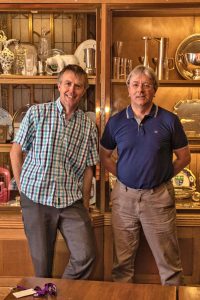
His descendants, David and Peter Chapman (shown above) are Liberal Democrat councillors in Luton.
Diary of Destruction – Dr Lloyd
Dr Lloyd and his wife, Maud, were staying at a relative’s in George Street, opposite the town hall, when the riot broke out. Maud wrote in her diary:
The mayor tried to make two speeches but the mob would not let us hear. After the procession the town council returned into the town hall and shut the door, only four policemen were left to guard it and soon it was forced. … The mob burned the town hall and wrecked the shops near, throwing bricks and bottles at the firemen.
Dr Lloyd treated some of those injured in the riots and later received a letter of thanks from the town clerk.
This player uses cookies in accordance with soundcloud’s cookies policy. They may collect usage data for analytics purposes.
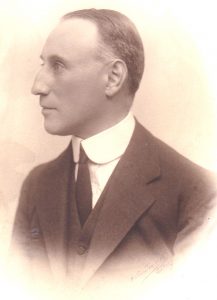
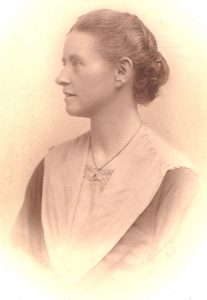
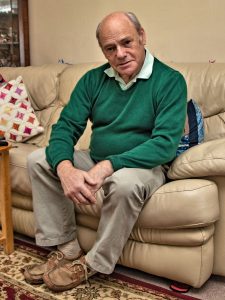
Dr Lloyd and his wife Maud – below their grandson Stephen Lloyd
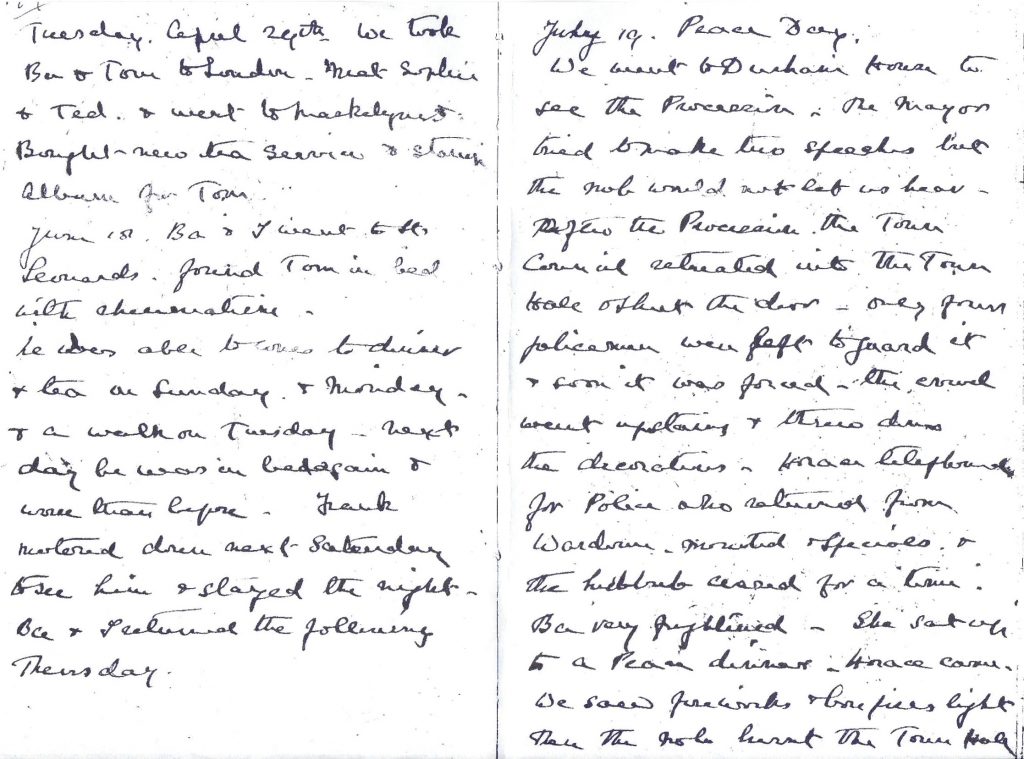
Maud Lloyd’s diary entries from Peace Day, 1919.
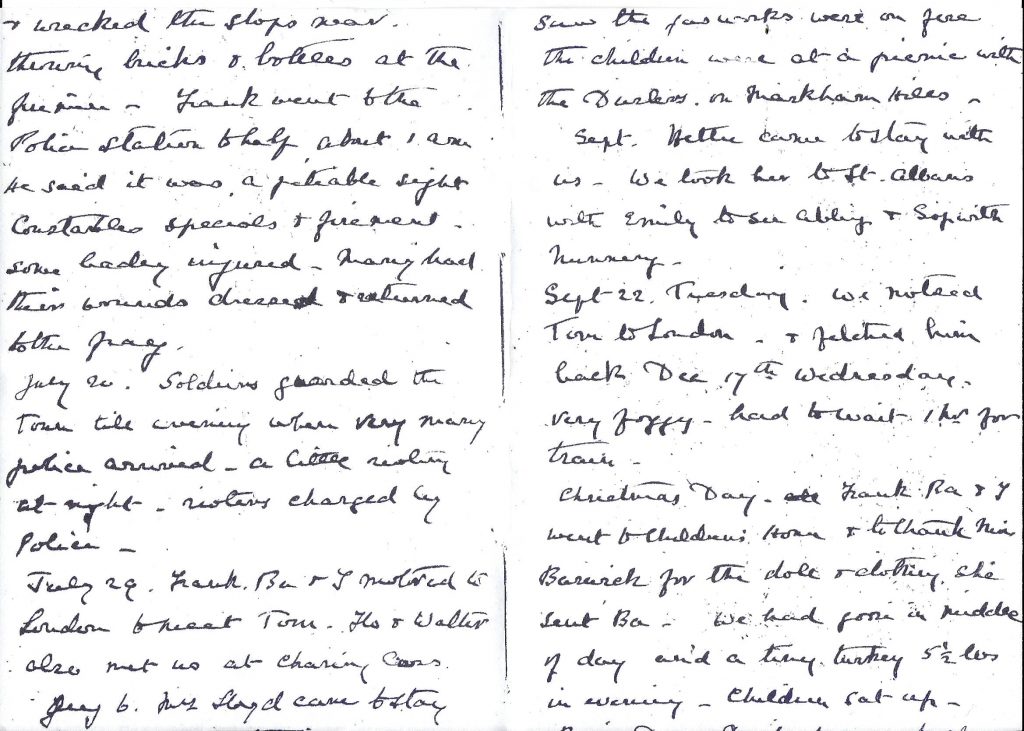
Stephen has transcribed part of the diary entry below:
July 19. Peace Day: We went to Durham House (opposite the Town Hall) to see the procession. The Mayor tried to make 2 speeches, but the mob would not let us hear. After the procession the Town Council returned into the Town Hall and shut the door, only 4 policemen were left to guard it and soon it was forced. The crowd went upstairs and threw down the decorations. Horace telephoned for the police who returned from Wardown, mounted and specials and the hubbub ceased for a time. Ba very frightened. She sat up to a Peace Dinner. Horace came. We saw fireworks and bonfires light. Then the mob burned the Town Hall and wrecked the shops near, throwing bricks and bottles at the firemen. Frank went to the Police Station to help about 1 a.m. He said it was a pitiable sight. Constables, specials and firemen, some badly injured, many had their nds dressed and returned to the fray.
July 20: Soldiers guarded the town till evening when very many police arrived. A little rioting at night. Rioters charged by police
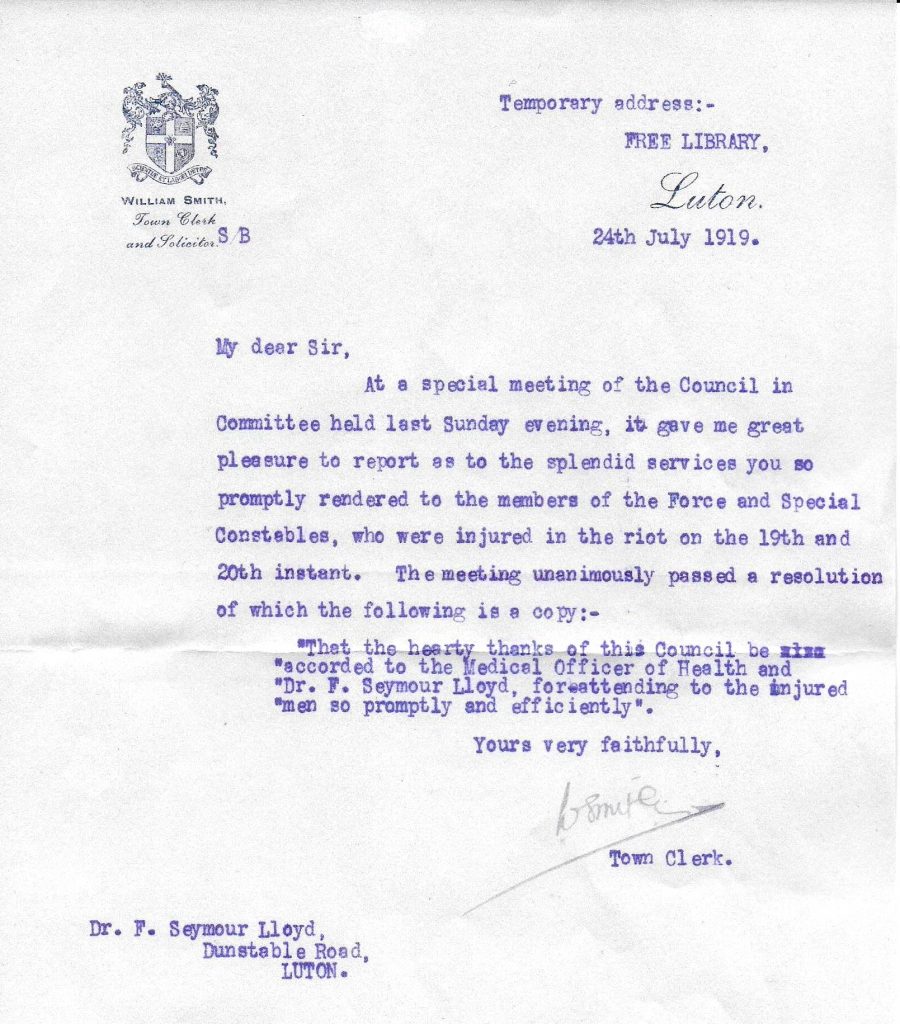
…and the response from Luton Council thanking Dr Lloyd for his efforts on the night of the riots. Note the use of a “Temporary” address!
Stephen’s grandmother was Constance Maud Lloyd [née Sworder, 1871-1963], shown above right.
Durham House, mentioned in the diary, was opposite the Town Hall and later sold to J Sainsbury. It was where Dr Horace Sworder lived. Stephen’s grandfather, Dr Francis S Lloyd [Frank, 1874-1968], had joined Dr Sworder’s practice and had married into the Sworder family in 1905. Ba was Stephen’s aunt Barbara [1907-1986], and Tom was his father, later Dr Thomas E S Lloyd [1908-1967], who practised in Luton for the remainder of his life.
Local Historian – Nigel Lutt
Nigel Lutt, a local Bedfordshire historian, researched the life of William Ephraim Gore who he described as a soldier who served successfully in the South African War, but had a more trouble experience in WW1 where he was imprisoned for insubordination. His life in Luton from a young age, was one of engaging in low level criminality having been convicted of 41 offences by the time of his sentencing in 1919 for his part in settling light to the Town. After completing his sentence of 9 months, he had no further convictions dying in 1956 aged 82.
Nigel Lutt’s views on Henry Impey
This player uses cookies in accordance with soundcloud’s cookies policy. They may collect usage data for analytics purposes.
Nigel Lutt’s views on William Gore
This player uses cookies in accordance with soundcloud’s cookies policy. They may collect usage data for analytics purposes.
Nigel Lutt’s views on the riots
This player uses cookies in accordance with soundcloud’s cookies policy. They may collect usage data for analytics purposes.
Reading the Riot Act – Roy Pilkington
Roy Pilkington worked for the Oakley Brothers who gave extensive public service to the people of Luton and were involved in the purchase of Wardown Park and its gifting to the Town. Roy was told that on the 19th July 1919 Edwin Oakley, a serving Councillor, was the person who read the Riot Act as the unrest and disturbances spread across the Town Centre.
This player uses cookies in accordance with soundcloud’s cookies policy. They may collect usage data for analytics purposes.
Family Perspective – Heather Lake
Heather Lake is Mayor Henry Impey’s great niece.
Heather heard vivid stories of the day that the Town Hall was burned down from her mother. Three of Heather’s mother’s elder brothers went into town that day and mounted police arrived from London by train to clear the streets. One of the brothers, Fred Randall, ran the wrong way and became separated from the others. He ran from the Town Hall towards High Town to the top of Lea Road, where he lived, and heard horses so he ducked into an alleyway. The police shone a torch down the alley but being very thin, he was able to pin himself to a gate and breathe in until they had passed. Fred eventually managed to run home and was severely reprimanded by his father! Heather’s mother remembers hearing pianos being played and the sound of fireworks. The next day she and her grandmother were horrified at seeing the charred remains of the Town Hall in George Street, a memory that stayed with Heather’s mother all of her life.
This player uses cookies in accordance with soundcloud’s cookies policy. They may collect usage data for analytics purposes.
Heather’s mother remembers what Emily told her about Henry Impey. He was a kind, well-liked man. He married but had no children. He came from a Methodist family and was a lay preacher and councillor before becoming mayor.
Henry’s wife later had a nervous breakdown and Henry was taken ill. Heather’s mother felt that the events of that day destroyed the Impeys. Henry could never come back to Luton where he was born and bred, despite all the years’ service he had given to the town. Neither of them ever recovered.
There a plaque commemorating Henry Impey in the Methodist church in Castle Street, which his descendants see when they attend.
This player uses cookies in accordance with soundcloud’s cookies policy. They may collect usage data for analytics purposes.
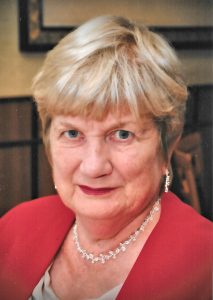
Heather Lake, Mayor Impey’s great niece.
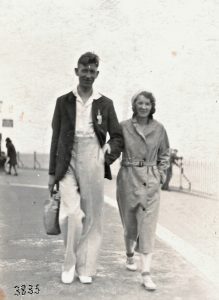
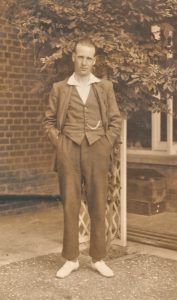
The couple shown above are Heather Lake’s mother and father; Dorothy (who told the stories to Heather ) and Stanley Impey (Stanley was a cousin of Henry Impey). The chap on his own in the image on the right is Dorothy’s brother, Frederick Randall, the person, who, in the story, hid from the mounted police.
Personal Histories Pamphlet
Working with the University of Bedfordshire Cultural History CIC have produced a pamphlet – shown below – that summarises some of the stories. Free copies of the pamphlet were available at the many centenary events taking place in Luton over the summer.
